Transcript
Ben Fallon: On today's episode of “Ask Paul Tripp,” we actually have a question from somebody on the team here at Paul Tripp Ministries. Paul Tripp Ministries is a nonprofit organization that Paul and Steve Sarkisian founded back in 2006. My name is Ben Fallon and I serve as the executive director of that ministry, and we now have fifteen people on staff who creatively and administratively support Paul and take this Gospel Mission to the world. “Ask Paul Tripp” is just one of the many free resources that we produce.
Today's question, Paul, “What advice do you have for aspiring authors? What would you say to somebody who's considering the idea of writing a book?”
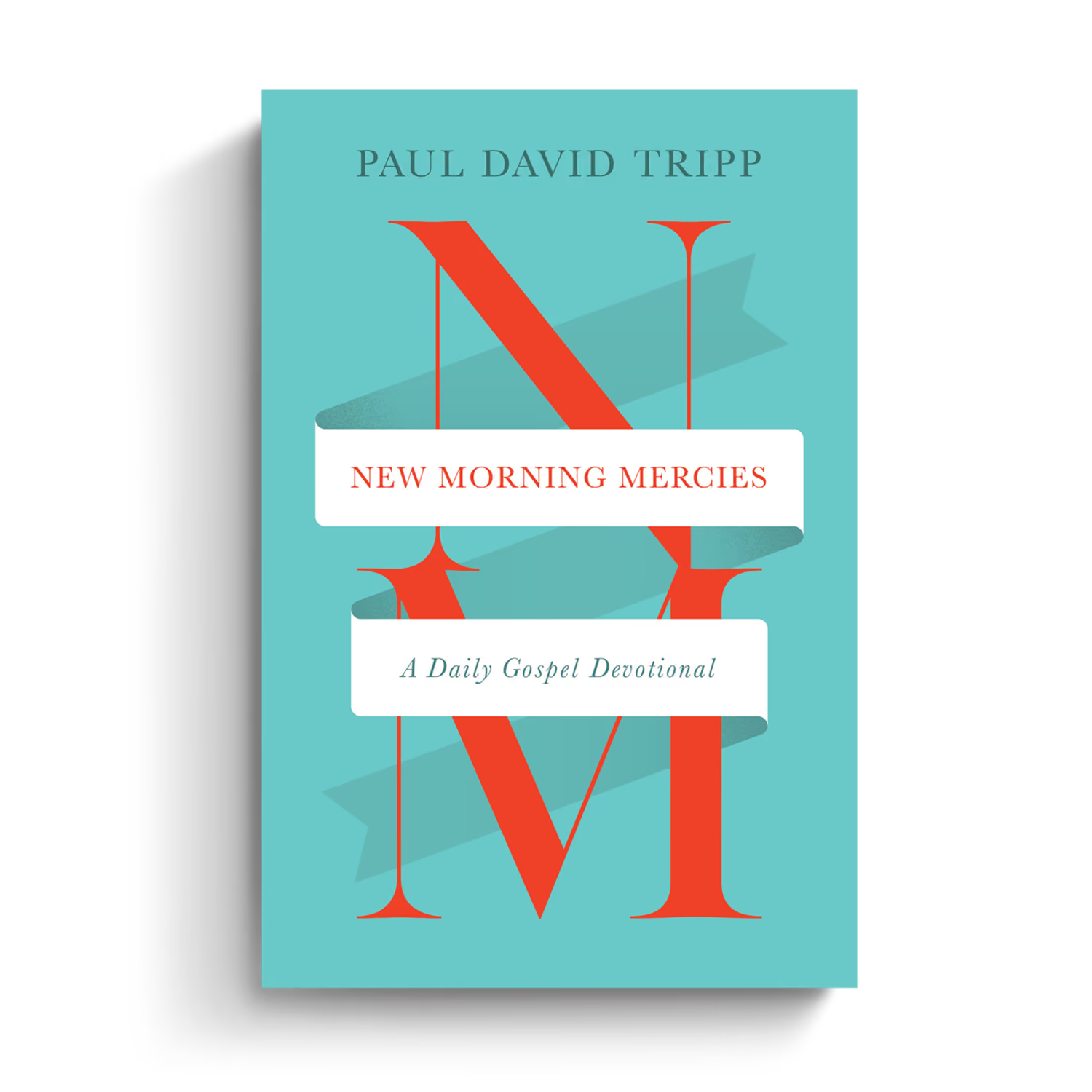
Paul Tripp: I love books, I've lived in books all of my life; even as a little boy, I was an avid reader. Books have shaped my view of myself and my view of God, and my Christian life and my marriage, and I can't tell you how precious books are to me. But that doesn't mean that everybody is an author. The first thing I say to people who say, “I think I want to write a book,” I always say them, “If you can do anything else, don't write.” That's because I am very persuaded that writing is a unique calling that not everyone is given. You have to have something to say that's a unique contribution to the human and Christian community; you have to have the ability to communicate that, and that is an enormous amount of work.
The fact of the matter is, this is not just true in a Christian book, but all books. Most books that are published get a very small reading. If you think that you're going to have a massive audience because you have something special to say, it just very seldom happens. Most books sell 500, 1000, maybe 2000 copies, if it's a really good book, and very few books become culturally known and influential. So, you have to you have to start there. This is often very hard labor for very small reward.
When I was at the Christian Counseling Education Foundation in Westminster, I walked into Ed Welch's office, who's a faculty member, and I said, “I want to write a book.” He gave me the best advice ever. He said, “Don't! Don't write!” He said, “I think you probably just want to write because you're surrounded by people who are writing.” And he said, “You wait until you're at a place where you literally cannot not write this book, and then we'll talk again.” I was very, very thankful for that advice, and it's exactly what I did.
So how did I come to the place of being a writer myself? I'm so thankful this is part of my story because when I start another book, I always think, “Am I fooling myself or what? Who cares what Paul Tripp puts on a page? Maybe this is just an act of arrogance.” Well, I had counseled the teenage son, who was losing his way, of a professor at Westminster Seminary. He came in one day and asked if I would counsel his son, I said, “Sure, I’d be glad to.” And that counselling went very well and there was a remarkable change in that young man's life. And after I was done, this professor came to me, who had been published again and again, and said, “What you did with my son you should turn into a book written to parents, because parents need help out there, and I'll help you get published.” I had no thought of writing at that point because I decided I would just wait. But I thought maybe this is the exact calling that I was waiting for.
And so, I sat down and put together an outline, each part of the outline became a chapter, and then I wrote a paragraph describing the content of each chapter, and I looked at it, and I thought, “I have a book.” And that book came out in 1997, end of 96, called Age of Opportunity about parenting teens. Now, I wasn't a writer, in any way, shape, or form. All my communication and ministry had been oral. And so, when the manuscript came back, it was a physical paper manuscript, unlike what we use today, my editor used a red pen. Every page was solid red; it looked like a bad transfusion. And just devastated, I went to my editor, and said, “I guess I should just give up writing.” And she said, “No, the content of this book is wonderful. But you have to learn how to communicate in a written form.” And over the first two or three books, she taught me how to write, and that launched me. For most of us, writing is not the most intuitive form of communication, so, it takes training and learning.
The last thing I would say is, “If you're beginning to write, give up the hope that you'll be the next Hemingway.” Those names we all know because they're generational. You may write a little book that will help a few people, and that's a wonderful thing. But the big names that you hear about are rare. If I could give one rather humorous example. Possibly everybody knows Rick Warren's book, The Purpose Driven Life. It has sold more copies in the English language than any other book but the Bible; I think it’s over forty million. Every publisher became plagued by that because everybody thought, “Maybe I'm the next Rick Warren. Maybe my book…” And so, I've had a publisher say this to me, I know many writers have, “You will not be Rick Warren!” That happens once in a lifetime, and if you have something to say, and we think it's worthwhile putting out, be thankful, but it probably won't reach that level of cultural influence.”
BF: So did you ever have any dreams or aspirations of being an author prior to that manuscript of Age of Opportunity, or no?
PT: Well, I did, I did, because I was in an academic community where everybody was writing. But what I didn’t have was a sense of calling; there's a difference between aspiration and calling. I think when that professor came to me, and said, “I don't know what you did with my son, and I would like to know, and I'm sure there are hundreds-of-thousands of parents who would like to know, see if you can turn this into a book.” Then I began to get this sense of calling, and once I had an outline with paragraphs for every chapter, that was a book, I thought, “I can do this.” And I did!
BF: Now you haven't written a The Purpose Driven Life and sold tens-of-millions of copies of a book, but you have sold several million and you have more than thirty titles out there now. Did you ever see your life playing out like this?
PT: I never anticipated that my greatest contribution to the church would be in writing. I was known for my ability as a speaker and had a lot of opportunities that way. And I never thought that millions of my books would be purchased. That to me, to this day, doesn't make any sense. I know me! The first audience of my books is me because I'm a mess. I always write with a heart to examine myself as I'm writing and the fact that others have been helped by my books is a great gospel mystery, and the fact that millions of people have been helped by my books is astounding to me. And I'm very thankful that God used one man to say, “You ought to put what you know down on paper,” and that conversation literally changed the course of my life.
BF: If you've been blessed by the “Ask Paul Tripp Podcast” or any of the free resources that Paul Tripp Ministries produces, we could use your help. As a nonprofit organization, we're 89% funded by the generosity of our donors. If you feel led, and as you are able, please consider Paul Tripp Ministries in your annual giving plan. You can learn more or make a donation at paultripp.com/give, or you can email give@paultripp.com, and someone from our donor partnerships team would love to connect with you. Thank you. We could never do this on our own. “Ministry,” as Paul says, “is always a community project!”
You have permission to print, repost, share, distribute, and translate this resource as long as you credit Paul Tripp as the teacher, do not charge for this resource, and do not alter the content in any way. If you require an exception or special permission, please email Teaching@PaulTripp.com.