Transcript
Ben Fallon: Paul, today's question comes from someone who is reading your daily Bible reading plan found in your daily devotional, Everyday Gospel. They've hit Genesis 9, when Noah gets drunk and passes out naked in his tent. “Why is it that Ham, and not only Ham, but his descendants too, are cursed? Wasn't Noah and his sin of drunkenness at fault here? The story seems a bit harsh."
Paul Tripp: So, I want to read the biblical passage this story comes from because there are just elements in the passage that are really important.
Noah began to be a man of the soil, and he planted a vineyard. He drank of the wine and became drunk and lay uncovered in his tent. And Ham, the father of Canaan, saw the nakedness of his father and told his two brothers outside. Then Shem and Japheth took a garment, laid it on both of their shoulders, and walked backward and covered the nakedness of their father. Their faces were turned backward, and they did not see their father's nakedness. When Noah awoke from his wine and knew what his youngest son had done to him, he said, “Cursed be Canaan; a servant of servants shall he be to his brothers.” He also said, “Blessed be the LORD, the God of Shem; and let Canaan be a servant. May God enlarge Japheth, and let him dwell in the tents of Shem, and let Canaan be his servant.” (That's Genesis 9:20-27.)
This is surely one of the saddest stories in the Old Testament, maybe in Scripture, because it comes on the heels of the glory of God saving Noah and his family from that great flood, and afterwards, restating to Noah and his descendants the covenant that he had made with Abraham. It's a beautiful story of God's grace and God continuing with zeal to fulfill his promises. So, you have this high moment of glory, and then you come crashing down like Adam and Eve, created in the garden of God's blessing. It's just so beautiful, and then it's like you hit a brick wall all of a sudden; Noah, like Adam and Eve, has a terrible moral fall after God's blessing.
As he's lying drunk and naked, Ham comes into his tent, and what he does next tells you everything about this man's heart. Rather than wanting to cover his father and not let this man be exposed to further dishonor and ridicule, he goes and gets his brothers to show him. He's rejoicing in this evil moment. He's having fun. This is like a teenage kid who's excitedly showing his friends a naked picture that came up on his phone–that's what Ham is doing. He's finding some kind of enjoyment, some kind of satisfaction in what God forbids.
So, it's important in this story to notice that the biblical author wants you to see very clearly the contrast between Ham's response, and Shem and Japheth's response. Those two brothers, this is just amazing, they put a blanket on their shoulders, and they back into the room till they get to their father, and they drop the blanket on him without looking because their heads are facing the other direction. That's pretty amazing! It's a response of knowing that what's going on is awful and dark, and they don't want to be part of it. They don't want to find joy in it. It's a response of honor and respect to this man who is their father. Ham's response was impure, dishonoring, disrespectful, and because it was, it was not just a sin against his father; it was a sin against God. The brothers were faced with the very same temptation, the very same situation. But their response was pure, honorable, and respectful, not only to their father, but in the sight of God. In this moment, as I've said, the true heart of Ham is exposed.
Now you have to ask yourself this question, and you should always ask yourself these questions as you're reading through Scripture, “Why in the world is this dark story preserved for us?” And I believe this passage has been recorded and preserved for us because God loves us; he knows the temptations of the world we live in and he’s aware of our weakness and susceptibility. And in this story, we are lovingly warned that God takes sin seriously, and so should we.
Where is there hope in this passage? Well, because it points us to the cross. We are Ham. We have found joy in things that God forbids. We sometimes find evil attractive. We often participate in things that are on the other side of God's moral boundaries in thought, word, or action. And so, we naturally live under God's curse, just like Ham did. And so, we celebrate the words of Romans 8:1, “There is therefore now no condemnation to those who are in Christ Jesus.” Jesus took our curse on himself, paying the full penalty of our curse, which was death, so that we would never face that curse again. That's what it means when Jesus said, “It is finished,” that the penalty is over.
And if you are in Christ, that means nothing in your life is a punishment for sin because Jesus took all of your punishment. Trials aren't a punishment for sin; sickness isn't a punishment for sin because Jesus carried your punishment. So, the story of Ham is really a finger that points us to the cross. It really is a cry for the person and work of Jesus, who has come and who has broken the curse that was over our head. And for that, we can celebrate!
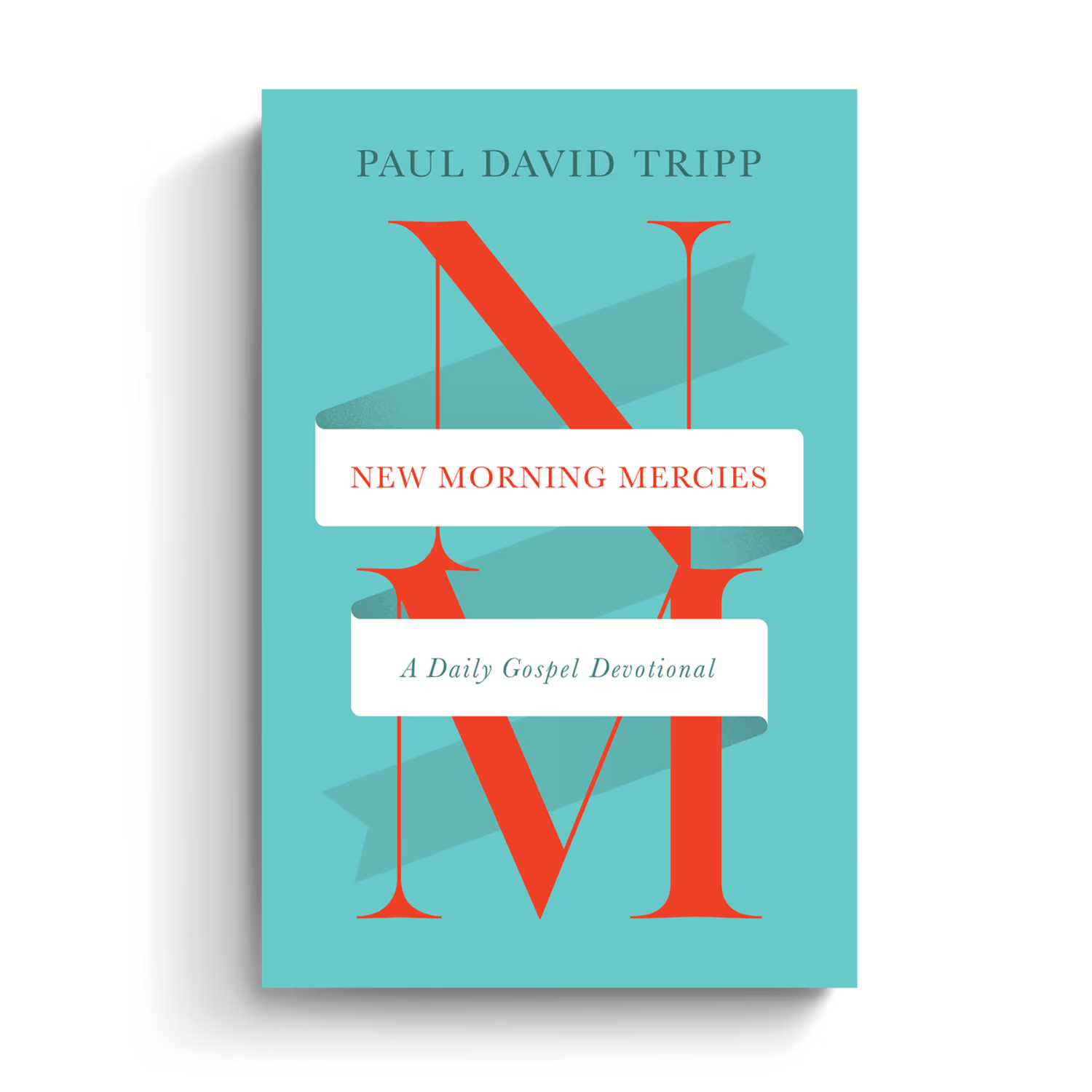
BF: Well, ten years after writing his popular New Morning Mercy's Daily Devotional, Paul wrote a second one called Everyday Gospel. It follows a Bible-in-a-year reading plan where you'll be assigned a portion of Scripture, and then Paul writes a brief devotional out of a specific section from that passage. So, in today's example, the Bible reading plan covered Genesis 8 through 11, and then Paul's devotional was written about the Tower of Babel. Now you can learn more about this resource, either the Bible or the devotional only, at paultripp.com/everydaygospel.
You have permission to print, repost, share, distribute, and translate this resource as long as you credit Paul Tripp as the teacher, do not charge for this resource, and do not alter the content in any way. If you require an exception or special permission, please email Info@PaulTripp.com.