Transcript
Ben Fallon: Paul, today's submission comes from Will, who is reading through your Everyday Gospel Devotional, and he has a question that comes out of the March 18th entry. Now, these Ask Paul Tripp episodes are often recorded months after we first receive the question, which is why this episode is being released for the first time in November of 2025, and we're only getting to Will's question eight months later now, but that is beside the point. I just wanted to give a little context to those who are listening or watching or reading the transcript.
So, in that March 18th entry, you begin with, “The problem with partial obedience is that it is disobedience masquerading as obedience.” Now, that devotional comes in the Old Testament reading plan when the Israelites were obeying the law given to their nation in the book of Judges, so Will was wondering, “Even though this isn't really the direction or the intent of your devotional entry, but it's still a valid question, which Old Testament laws do we still need to obey today? Are we not being fully obedient to Christ if we are only partially obeying, even picking and choosing which Old Testament laws to obey?”
Paul Tripp: Well, this question about law in the Bible just reminds me of how much I love these questions, and what a privilege I have of answering them. It's just, this is my rendition of fun, thinking through what the Bible has to say about these issues. I don't ever look down on these questions, and I really want to give them meaningful, clear, applicable answers, and this is one that I think is really important because it has practical implications for understanding what my responsibility is as a child of God. And that has implications no matter whether a young person or an old person, single or married, with children, without children, as a worker, as a citizen, as a neighbor, as a member of the church.
So, in order to answer this question, you know, we really need to define what is meant by Old Testament laws. Old Testament laws fall into three categories. The first are “Ceremonial Laws.” They have to do with the sacrificial system and the feast days that God ordained for his people in the Old Testament. Second category are “Civil Laws.” Those are laws having to do with God's plan for the organization of the nation of Israel. And then there is the “Moral Law.” Those laws are an expression of God's unchanging will for the way that his creatures should relate to him, to one another, and to the world he created.
Now, God had always planned, before the foundation of the earth, that the ceremonial sacrificial system would be temporary, and at a certain point in time in his plan, replaced by the person and work of Jesus. Jesus, we all know, is the final sacrificial Lamb, forever satisfying God's requirement of an offering for sin. Jesus, once and for all paid sin's penalty, releasing us from all of the “Ceremonial Law's” obligations. Also, obviously, the “Civil Law,” having to do with Israel as a nation are no longer needed because the church is the new Israel. Paul says those who are in Christ are the seed of Abraham and are inheritors of the promises made to him. So, “Ceremonial Law” was temporary by God's plan. The “Civil Law” was temporary by God's plan. Those were written into God's plan before the foundations of the earth.
So, that leaves us with “God's Moral Law,” like the “Ten Commandments.” It's an expression of God's holy character and his eternal will for the conduct of those made in his image. And so, we are still called to obey those laws. Listen to Romans 13:8.
Owe no one anything, except to love each other, for the one who loves another has fulfilled the law. For the commandments, “You shall not commit adultery, You shall not murder, You shall not steal, You shall not covet,” and any other commandment, are summed up in this word: “You shall love your neighbor as yourself.” Love does no wrong to a neighbor; therefore love is the fulfilling of the law.
Besides this you know the time, that the hour has come for you to wake from sleep. For salvation is nearer to us now than when we first believed. The night is far gone; the day is at hand. So then let us cast off the works of darkness and put on the armor of light. Let us walk properly as in the daytime, not in orgies and drunkenness, not in sexual immorality and sensuality, not in quarreling and jealousy.
Now, notice what Paul does here. He not only restates the Old Testament law to the believers he's writing to, but he says that Jesus summarized that law in the two great commands. So, when Jesus says, “Love God above all else, and love your neighbor as yourself,” he is actually summarizing the two parts of the “Ten Commandments.” The first part of the “Ten Commandments” has to do with the worship of God and the forsaking of idols, and the second part has to do with the way that we live with one another. And so, when Jesus enunciates the two great commands, he is reaching back and dragging the moral law into the New Testament. And Paul is very aware of that, so he's letting us know, that by God's plan, the “Moral Law” is for us also, the new Israel, the church, God's loving guardrails for us.
Now, let's talk about law and gospel a little bit. The law was never intended by God to be the means of gaining relationship with him, not even in the Old Testament. When Israel first was given the law on Mount Sinai, God had already placed his love on Israel, had already called them his special people, had already redeemed them from slavery. So, the law wasn't given as a means of gaining acceptance with God. No, never! And it is, again, a means of us living for the greater glory of God and is also given because God loves us and he wants his children to thrive. So, that means our standing before God is never based on keeping the law. Our standard is solely based on the sufficiency of the life, death, resurrection, and royal priestly reign of Jesus. We are in good standing with God, not because of the track record of our righteousness, but because of the perfect righteousness of Jesus. No passage says this better than 2 Corinthians 5:21, “For our sake, he (God) made him to be sin who knew no sin, so that in him we might become the righteousness of God.”
Theologians call this “The Great Exchange.” Our sin is passed over to Jesus, and his righteousness is passed over to us. How glorious is that! So, yes, I am called to willingly and joyfully stay inside of the moral boundaries of God's law, but I never understand that as a means of good standing with God because Jesus fully paid for that. I stand before God as righteous because of the gift of the righteousness of Christ on my behalf!
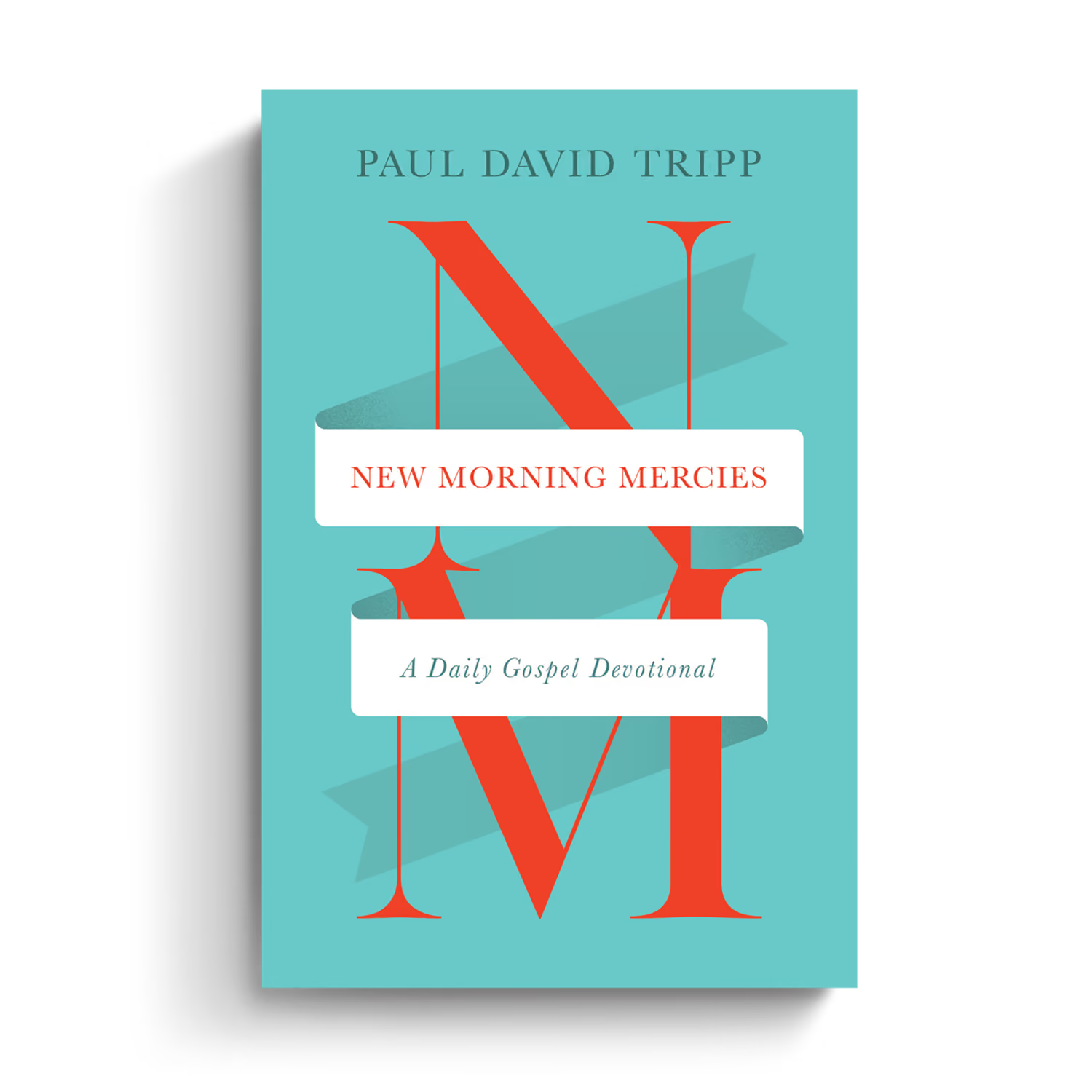
BF: Well, you can follow along with Paul's Bible in a year reading plan and his daily devotional commentary when you get a copy of Everyday Gospel: A Daily Devotional Connecting Scripture to All of Life. It's available just as a devotional book with 365 entries, like New Morning Mercies, or you can get the Everyday Gospel Bible, which contains the full text of the ESV Bible plus Paul's 365 entries in between the annual reading plan. Both of these are available at paultripp.com/everydaygospel.
You have permission to print, repost, share, distribute, and translate this resource as long as you credit Paul Tripp as the teacher, do not charge for this resource, and do not alter the content in any way. If you require an exception or special permission, please email Info@PaulTripp.com.