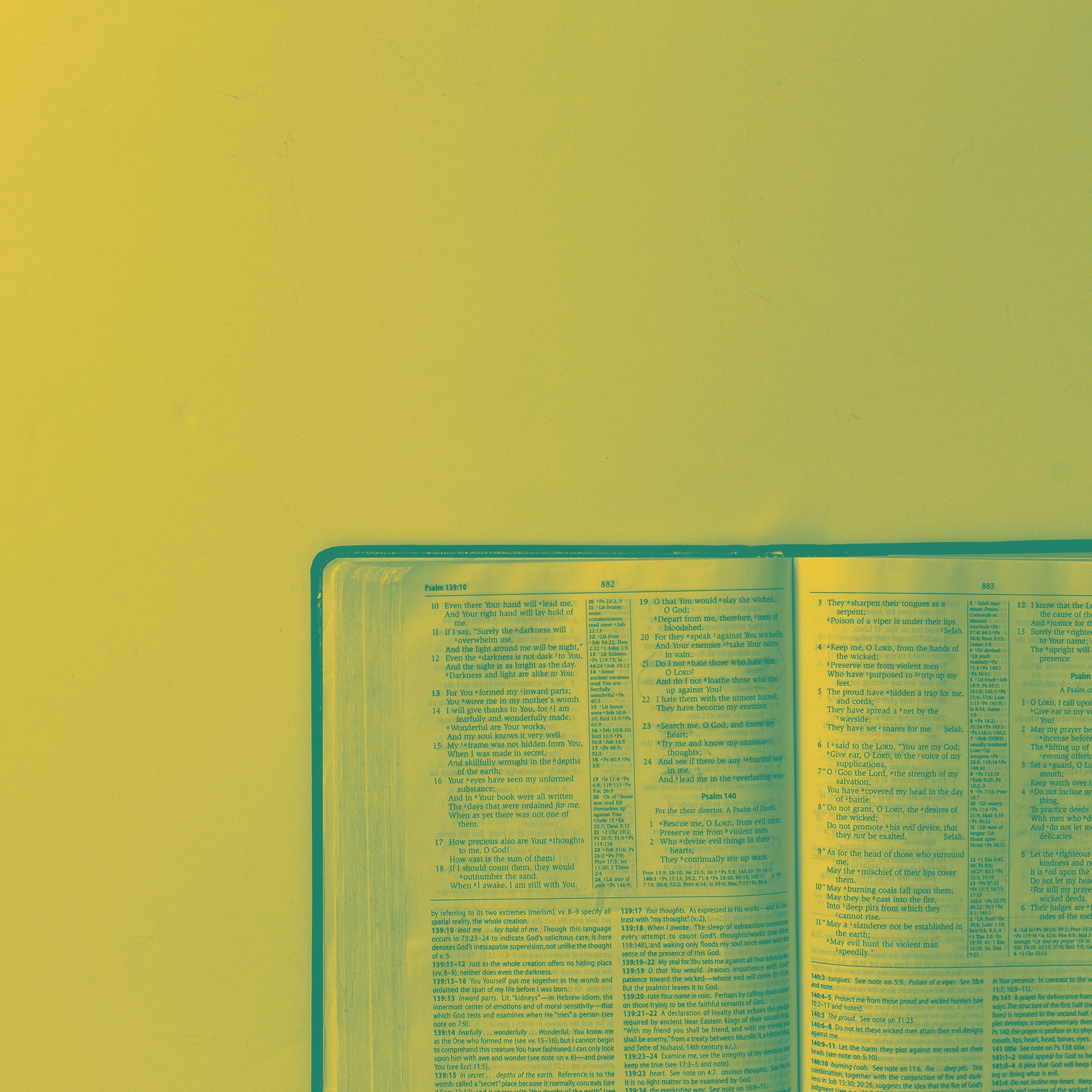
Well, we're going to look at Psalm 119. I'm not going to read all of Psalm 119 to you because it's 176 verses. Psalm 119 is longer than many of the entire books of the Bible. And it's hard to know what to say about Psalm 119--it is so big, so magnificent, almost beyond comparison, of any portion of Scripture. Like I said, at 176 verses, it could be a freestanding book of the Bible.
And the structure is very interesting. There are 22 stanzas of 8 verses each, following the 22 letters of the Hebrew alphabet in sequence. Within a stanza, the first word of each verse begins with the same letter--the letter to which the whole stanza corresponds. Now, that's pretty significant commitment to order.
Well, this Psalm that is so amazing and so well ordered is a celebration of one of God's sweetest, most precious, most essential gifts to us: the gift of his Word.
I've thought many times, where would I be without God's Word? What would I know? How would I make decisions? How would I face difficulty? How would I know what's right or wrong? How would I know what's wise or what's foolish?
I'm so thankful for God's gift of his Word. And there are a variety of words used in Psalm 119 for his Word: his law, his testimonies, his precepts, his statues, his commandments, and his Word.
I like what the ESV Study Bible says about this Psalm.
This Psalm reflects the view that the LORD, who abounds and steadfast love and faithfulness, and who, therefore, freely and fully forgives his people when they confess their sins, loves his people without limit, and, therefore, also guides the faithful in the way of life that is generally good and beautiful.
That's just beautiful. This forgiving, loving God gifted us with his Word because he knows we need its guidance.
The focus of this celebration of God's Word is not just on theological information; the focus is on the moral wisdom of God's Word. I think that's captured in verse 105 of Psalm 119, "Your word is a lamp to my feet and a light to my path."
Charles Spurgeon says, "If you're walking in unfamiliar pathway in the dark and the lamp is just on your head, your head and your feet will fall into a ditch."
It's beautiful; it says, "The word is a lamp to my feet." Pay attention to the word picture here. When you're walking at night through an unfamiliar place, you need something to shine on the pathway, on your feet, so you can know how to go. This is a picture of the practical, every day, guiding, and transforming wisdom of God's Word.
The Bible is never meant just as a body of mental information, not meant to be relegated to just the religious dimension of your life. It is given to guide everything you think, desire, say, and do. It's not just informational; it's meant to be transformational.
So, we have a guide for everything in our life because God's Word is the lamp to our feet and a light to our pathway given to us by the one who is himself wisdom.
Questions for Personal Reflection or Group Discussion
1. In the past, what has typically been your approach to reading, absorbing, and meditating on God's Word? Has it felt more like a duty or item to check off your list each day? Has it been approached by you as a chore or spiritual obligation that you complete without sincerity of heart or a posture of building a relationship? If so, why not pause and ask God to give you a fresh perspective on his Word that it might change from an obligation to a celebration each day? Ask him to give you a heart that longs for his Word the way you long to spend time with your favorite person. Ask him for a renewed zeal for the Bible in a way that can only be credited to his transforming grace in your life.
2. How has it been difficult for you to view God's Word as anything other than informational or knowledge to be gathered? Has the informational aspect of Scripture ever pierced your heart in a way that has transformed your everyday behaviors and attitudes? If not, why do you think that is? If so, in what ways have you seen specific changes in your day-to-day actions and thoughts? How has Scripture specifically been a lamp to your feet and a light to your path?
3. Take some time to evaluate the areas of your life that you know are not pleasing to God (actions, thoughts, motivations, words, etc.) and if you're feeling bold, write them down and share them with someone close to you like your spouse or an accountability partner. Then, instead of moving toward shame and guilt, preach the gospel to yourself and ask God to use his Word to transform you. Go through your list and ask the Lord to specifically weed out the areas you know are dishonoring to him and ask him to replace those areas with Holy Spirit-enabled change. Pray specific Scripture passages over your list and ask your spouse or friend you shared your list with to pray for you too.
Conversation Prompts to Use with Children
For Younger Children:
• Why is the Bible so important for us to not only read but obey? What if we obey but we don't really have the right heart or motivations when we obey the Bible? How can God's Word change us into people who look, act, speak, and think more like Jesus?
For Older Children:
• Do you think real change is actually possible for grown-ups who seem to be stuck in a rut of habitual sin? How have you seen God's Word change me (if at all)? How have you seen God's Word change you (if at all)? How can we pray for one another so that God might use his Word to change how we look, act, speak, and think more like Jesus?
• (If applicable): Will you forgive me for not allowing Scripture to change me? And will you keep me accountable to not only reading God's Word, but authentically applying it to my life so that I might become more and more like Jesus each day?
You have permission to print, repost, share, distribute, and translate this resource as long as you credit Paul Tripp as the teacher, do not charge for this resource, and do not alter the content in any way. If you require an exception or special permission, please email Info@PaulTripp.com.